

If you have less than 90 days to figure out how to show up in AI search engines using AEO and GEO, this is the guide to get you there. AI has completely changed how businesses find and communicate with prospects. It has also impacted how prospects choose who to trust and buy from and why. But despite the tech shifts, marketing’s role has not changed.
Marketing’s purpose is to create meaningful connections at every customer touchpoint to move prospects closer to conversion. AI summaries and conversations in ChatGPT, Gemini and other LLMs are now major customer touchpoints, which makes it essential to understand how to use AEO & GEO to build trust and conversion in AI marketing.
The difference between AEO, GEO & SEO
SEO is the traditional way of optimizing blogposts and website content for search engines so that they can mark each piece of content as the right response to a specific short-tail or long-tail keyword that the target audience types into the browser.
One of the major goals of SEO is to appear on the first page of search results and drive website visits.
With the advent of AI search engines, two primary things have changed:
- The way people search
- The way people interact with search results.
Instead of opening traditional browsers like Google Chrome and Bing, more people now chat directly with AI platforms like ChatGPT, Perplexity, Gemini, etc. This has created a space for AI marketing, and this is where GEO comes in.
What is Generative Engine Optimisation (GEO)?
Generative Engine Optimisation (GEO) is the practice of structuring your content so that LLMs deem each piece a suitable contribution when collating responses to questions from users and cite your brand inside their responses.
But people are still searching on search engines. The only change is that queries are longer, hyper-specific, and sometimes multi-layered. This is why local SEO had to evolve into what we now call answer engine optimisation (AEO) – because the needs of users evolved beyond the purview of traditional SEO.
What is Answer Engine Optimisation (AEO)?
Answer Engine Optimisation (AEO) requires structuring your brand’s content so that it shows up as the direct answer in AI overviews, featured snippets, and voice search. You want to be the response your target audience sees first.
AI responses in search engines are still largely zero-click. Even though referenced sites now have clickable links, dropdowns, and text citations in AI overviews, data shows that a large percentage of user interaction is still zero-click. For your brand, this means that you have way more chances of people seeing your brand mentioned in search engines than people clicking through to visit your website.
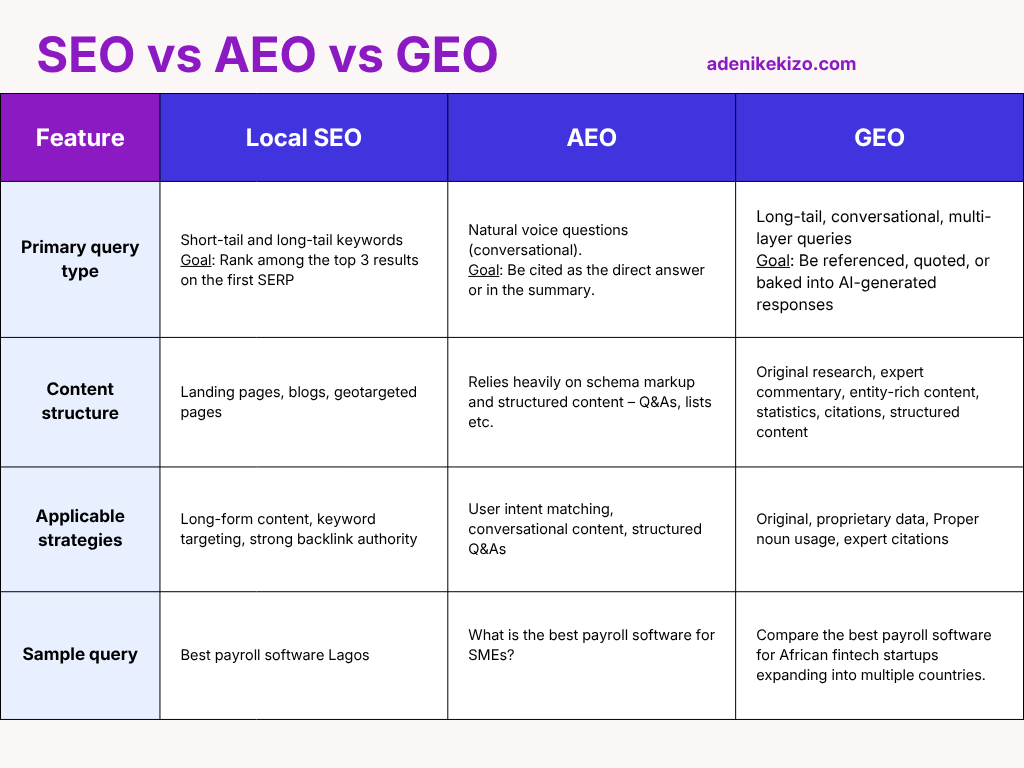
| Feature | Local SEO | AEO | GEO |
| Foundation | Builds on existing SEO foundation | Builds on existing SEO foundation | Is not based on SEO tactics. |
| Primary query type | Short-tail and long-tail keywords | Natural voice questions (conversational) | Long-tail, conversational, multi-layer queries |
| Content structure | Landing pages, blogs, and geotargeted pages | Relies heavily on schema markup and structured content – Q&As, lists etc. | Original research, expert commentary, entity-rich content, statistics, citations, structured content |
| Goal | Rank among the top 3 results on the first SERP | Be cited as the direct answer or in the summary. | Be referenced, quoted, or synthesized within AI-generated responses |
| Platform | Traditional search engines, including Google and Bing | Voice search (Siri, Alexa), featured snippets. | Large Language Models like ChatGPT, Perplexity, and Gemini |
| Possible winning strategy | Long-form content, keyword targeting, strong backlink authority | User intent matching, conversational content, structured Q&As | Original, proprietary data, Proper noun usage, expert citations |
| Content Freshness Requirement | Moderate | High | Very high for topics where AI systems prioritize recent and authoritative information |
| User click behavior | High CTR | Moderate to low CTR | Predominantly zero-click |
| Example Query | Best payroll software Lagos | What is the best payroll software for SMEs? | Compare the best payroll software for African fintech startups expanding into multiple countries. |
To win in AI search, you need to win at both AEO and GEO.
How to show up in AI answers with Answer Engine Optimisation (AEO)
To show up in AI answers with answer engine optimisation (AEO), you must understand that it is about providing answers that respond accurately to questions users have. Your content should lead with answer-first content within the first 40 to 60 words on every page.
The keyword here is structure.
You can structure your content as an FAQ or HowTo content, depending on the objective. If you are structuring your content as FAQ, then you should use an FAQ schema to tell search engines which parts of your content are questions and answers. This will give you more visual space in AI search results. You can also use the HowTo schema if that better suits your needs.
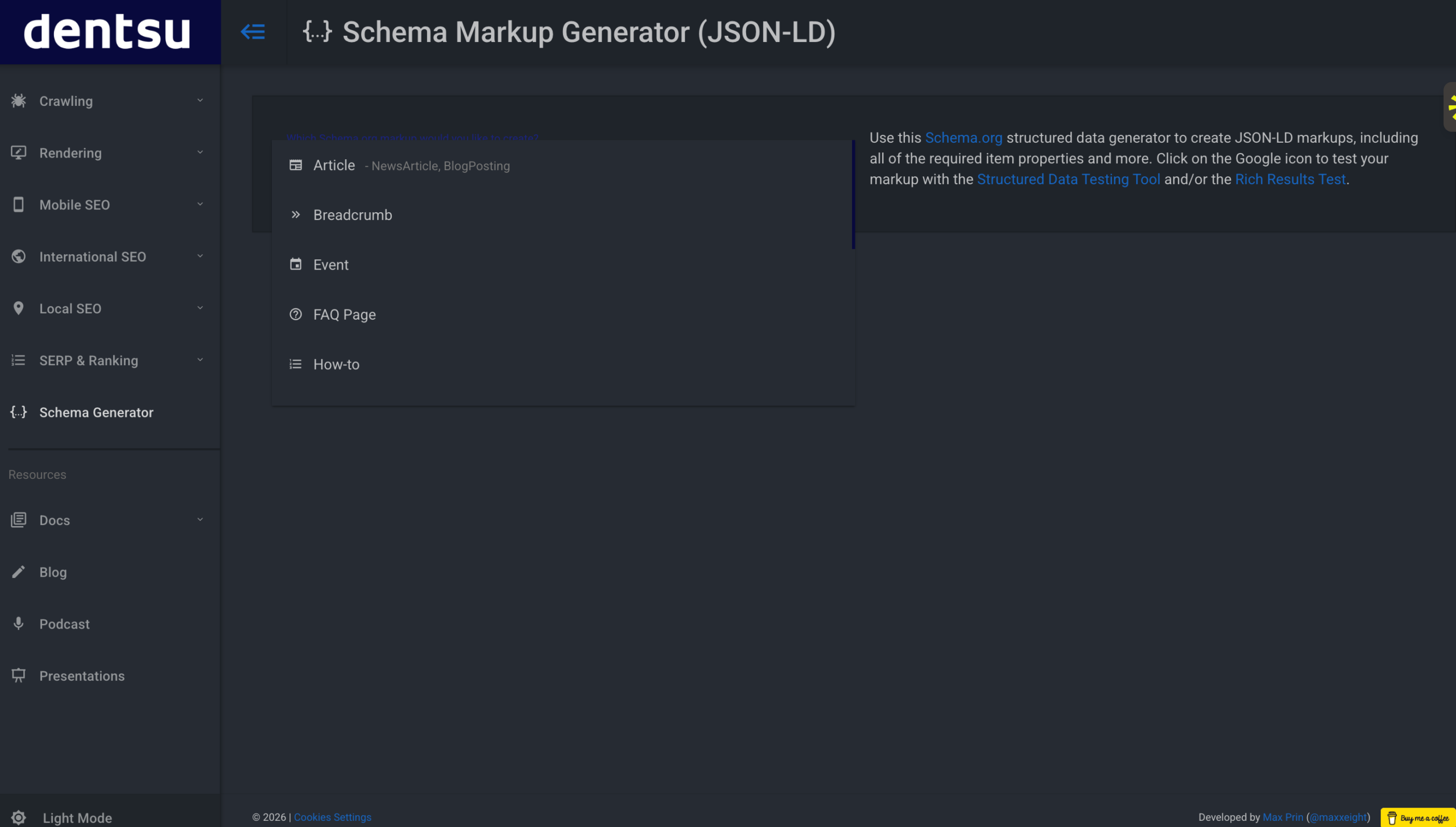
Tools you can use to structure your content in a way that AI understands include Merkle Schema Markup Generator, Schema.dev, and Microdata Generator by SEOChat.
In addition to schemas, making your headings conversational or even direct user questions will make your content understandable and signal its relevance to search engines.
People also read What is a Go-to-Market (GTM) Strategy Template? A Marketer’s Guide to Scalable & Efficient Pipeline Growth
Why is answer engine optimisation important?
Answer engine optimisation is important because it helps your brand:
- Become the referenced expert on specific questions and topics in your market category.
- Keeps your brand’s visibility and recall high even though fewer users are clicking through to actual website links.
- Gives you voice search ownership on mobile devices.
- Build brand authority and win zero-click queries inside Google AI overviews.
How to know if your answer engine optimisation is working (Metrics)
The metrics that show if your AEO strategy is working are different from those of traditional SEO. Track:
Featured snippets mention: This routinely monitors the number of featured snippets you own in your category.
Voice search visibility: This tells you how many times your brand is referenced in voice search queries across devices.
AI overview win rate: This shows you how many times your brand’s content is displayed in the AI overview.
Zero-click reach: this tells you what your brand impressions are from AI search engines, especially when people do not click through to your website.
How to get cited in LLMs using Generative Engine Optimisation (GEO)
To win with generative engine optimisation, your goal is to get your brand cited directly inside the collated response of LLMs like ChatGPT, Perplexity and Gemini. For context, about 800 million people chat with ChatGPT daily, Perplexity processes about 780 million queries a month, and 68% of all Google searches end without the user clicking to any website.
People are asking LLMs different types of questions. Some of those questions fall in your brand’s market category. Your mission is to ensure that your brand is mentioned or positioned as the best option inside the response curated by each LLM for the user.
The keyword here is trust.
In AI search, you want your brand to be positioned as a trusted source amidst the multiple input sources the LLM drew its response from.
Create authority content for your category
For a b2b brand, it is important to stay in close communication with your target audience and understand what they usually search for or ask during the buying process for products in your market category.
Some of the questions your prospects ask LLMs will include:
- Best-of or comparisons of similar products that seem to fit their needs
- Alternatives to your product or their current tool that can fulfil their goals
- Reports with original data on industry trends that can impact their business
- Reviews on your products and those of competitors
The next step is to create content with all of these conversational directions as a strategy. Create best-of, alternative-to, and comparison content in your market category for different channels, including LinkedIn, review sites, forums, and your website.
But there’s more.
AI search engines require proper nouns for specificity
Ensure you introduce proper nouns and original data into your content as often as you can. Proper nouns like the ones highlighted in the example below give LLMs specificity and solid context. They need this specificity to ground their responses in hard facts during the Retrieval-Augmented Generation (RAG) process.
Generic example:
Our intelligence tool helps marketing teams analyze social media better and detect advantageous trends before others.
Specific example with proper nouns:
We use Brandwatch and Google BigQuery to analyze 40,000 TikTok videos across the UK and Germany so you can spot prime trends before your competitors do.
Creating original data in your market category is a goldmine because AI can’t fabricate original data. This ensures that LLMs have to credit you as the source whenever they use that data or reference a site that quotes your original data.
The AI must cite your website url as the factual source each time they use your data or a report created by your brand.
Build third-party signals on Reddit, Quora, and other forums.
It’s no secret that Reddit, LinkedIn, and other forums where real people engage in quality conversations are treasure troves of information for AI. That means it’s critical to get your brand mentioned across these forums and review sites. Create content that answers people’s conversational intent without being salesy, and where appropriate, link back to resources that make the threads more enriching.
Why is generative engine optimisation important in AI marketing?
Although GEO is harder to measure and requires consistent content efforts and time, the benefits are essential for business growth.
- It converts better, as data from HubSpot shows that AI referrals convert 3x higher than traditional search.
- There is less competition for your business compared to featured snippets, which means you have a stronger chance of dominating your market category.
- It drives brand visibility and conversion across ChatGPT, Perplexity, Gemini and other LLMs, compared to AEO, which works only in search engines like Chrome and Bing.
- It gives you first-mover access to buyers who start their buying research in an LLM instead of Google.
How to know if your generative engine optimisation (GEO) strategy is working
In AI marketing, these are the key metrics that let you know if your GEO strategy is working or if it should be tweaked:
AI share of voice: tells you how often your brand’s content appears in AI-generated answers versus your top three competitors.
Fanout coverage: shows you the range of queries that your content answers in LLMs.
Citation frequency: this gives you the big picture of how often your brand is referenced by LLMs as the source of a statistic or fact.
AI referral traffic: track the traffic coming to your brand purely from AI agents
Chunking success: tells you whether your content structuring strategy is working. It is working if specific blocks of your content – like bulleted lists or a table – are extracted directly into an AI result.
Chunking means formatting your content such that specific sections can be pulled directly to be a part of AI responses. This is important because AI only extracts sections, not whole pages.
An interesting thing to watch out for is an uptick in your branded search volume. If more people see your brand mentioned in LLMs, data shows that it drives a rising trend in searches for your exact brand name or proprietary product names, a win-win. I trust this will help you in setting up your own AEO/GEO strategy and in creating fresh content that will make your site a trusted source for AI search engines.
If you’d rather have an expert design your strategy and/or create the AEO & GEO content that will give your brand more share of voice in AI searches, I’d love to help. Reach out to me through the form below. Cheers.